Climate & Environment/Force / 06
Least responsible.
Most exposed.
Adaptation is the work. It is also the part that is hardest to finance, because it earns nothing.
The state of it/01
What is
actually at risk.
Forest cover in Sub-Saharan Africa fell to 25.7 percent of land area in 2023, down from 26.1 percent in 2021. Slow in percentage terms, permanent in practice.
Water is the sharper exposure. Only 32.4 percent of people in the region use a safely managed drinking water service, and that figure has moved barely a point in a year.
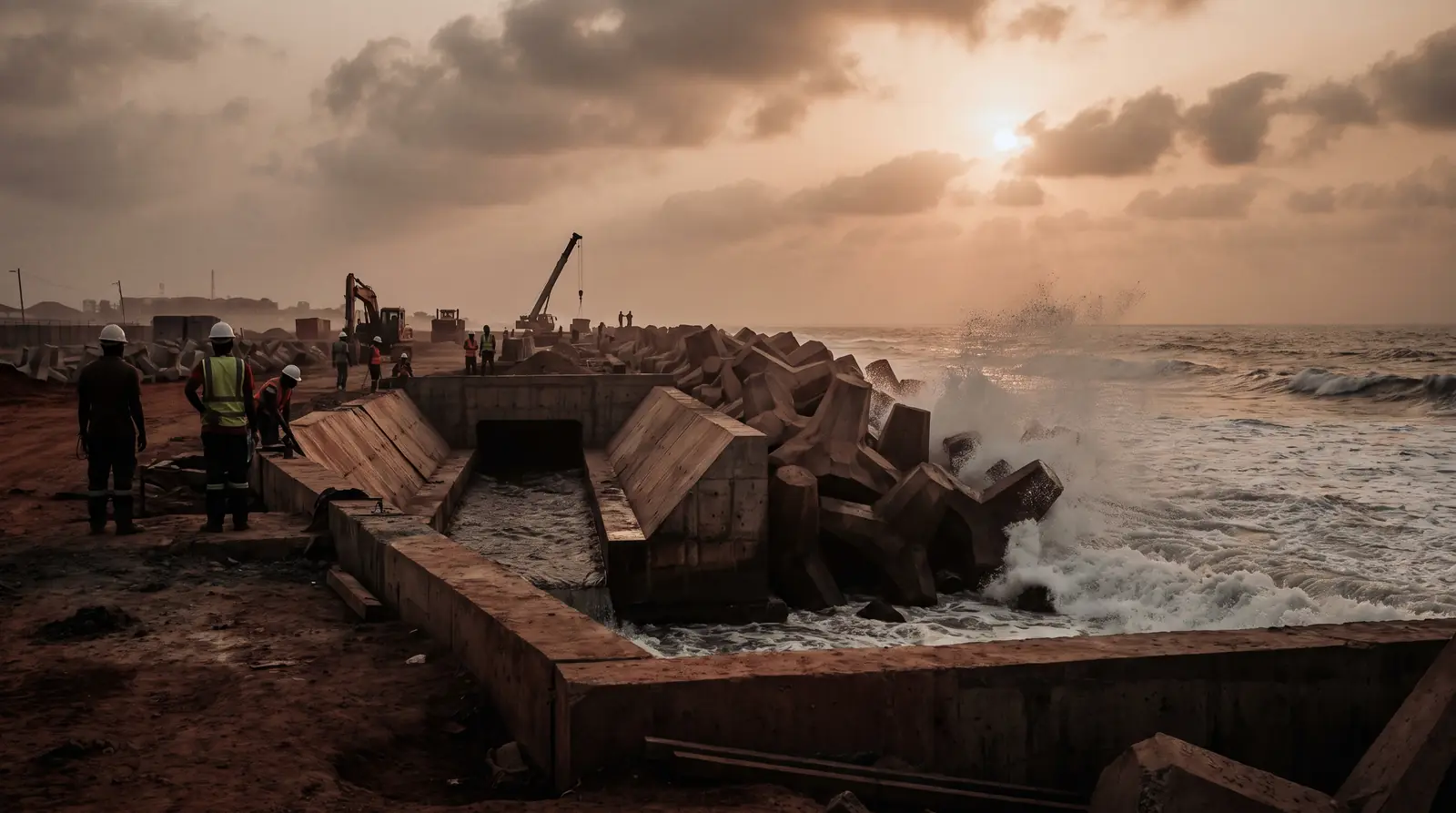
The visible risks are coastal. Much of West Africa's population and nearly all of its industry sit on a narrow, eroding shoreline where a storm surge reaches assets that took decades to build.
The less visible risk is agricultural. A shifted rainy season does not make the news, and it moves more household income than any single storm.
What decides it/02
What decides
whether defences hold.
Mitigation projects generate power, credits or a product, so they can be financed commercially. Adaptation prevents a loss that may not happen this decade, and prevention does not invoice.
That is why adaptation depends on public balance sheets and concessional money, and why it is chronically underfunded relative to the exposure it addresses.
Groynes, breakwaters and reclamation interrupt the natural drift of sand along a coast. Protect one stretch and the erosion usually reappears down-drift, often in a community with no engineering budget.
Coastal defence only works when it is planned at the scale of the whole littoral cell. Planned lot by lot, it is a transfer of damage rather than a reduction of it.
Most African urban flooding happens in systems that were adequately sized and are now blocked. The rainfall was survivable. The uncleared drain was not.
Clearing and maintaining drainage is the highest-return climate spend available in most cities, and it is almost never counted as climate spend.
A carbon project is usually a long commitment about what will not happen on a piece of land. That requires clear tenure, real enforcement and a community that benefits enough to keep to it.
Where any of the three is absent, the credit is fragile regardless of how the methodology reads.
What it means/03
Building first
is an advantage.
Cities still being laid out can put drainage, defence and tenure in from the start. Doing it early costs a fraction of doing it late. The continent is early.
The Brief/
The NextStep Africa
Brief.
What the engine turns up, every fortnight. From Lagos.
- What moved
- The change that mattered, and the number under it.
- How it connects
- The systems involved, and what one does to another.
- What it turns on
- What has to go right, and who is already building it.
- What to watch
- One indicator, and when it resolves.
SubscribeNO. 14 / T-09 DAYS
FREE. EVERY SECOND TUESDAY. READ BY DECISION-MAKERS ON THREE CONTINENTS. ONE CLICK TO LEAVE.
From the founder's desk.
NextStep Africa / Lagos