Cities & Infrastructure/Force / 01
A city arrives
before its pipes do.
African cities are filling faster than the systems under them are being laid.
The state of it/01
The building
is late.
Roughly 20.7 million people join Africa's urban population every year. Sub-Saharan urban growth is running at 3.6 percent a year. That is a megacity added every year, without pause.
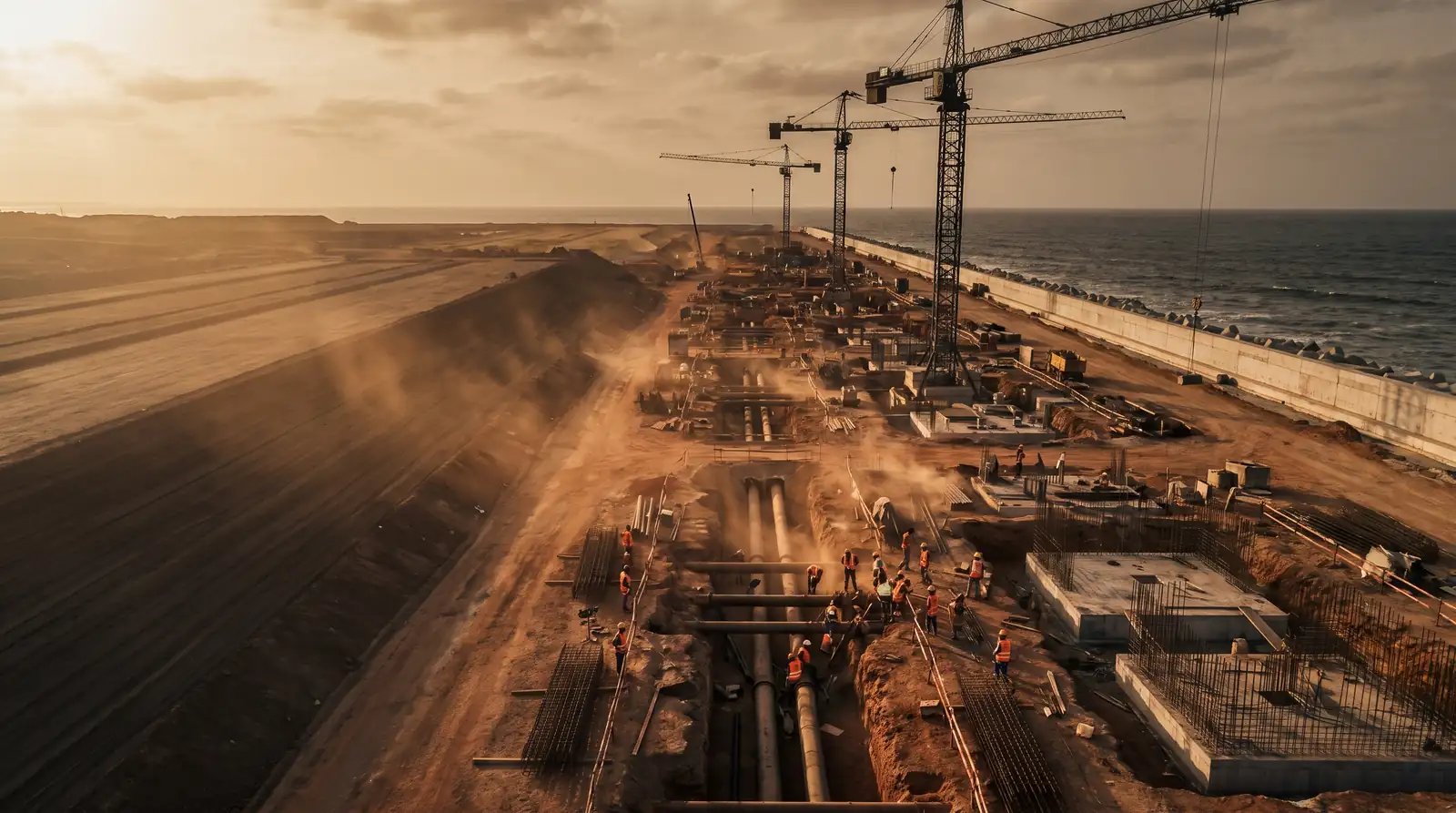
The buildings usually arrive. Housing goes up, informally and fast, because shelter cannot wait. What arrives late is everything underneath it: the trunk sewer, the substation, the arterial road, the drain that decides whether the street floods in August.
So the visible city runs ahead of the invisible one. That gap is the defining infrastructure problem on the continent, and it compounds. Retrofitting a pipe under a built street costs several times what laying it in open ground would have cost.
Ports and corridors sit in the same trap. A berth can be dredged in three years. The rail and road that feed it take ten, and pass through more jurisdictions.
What decides it/02
What decides
whether it gets built.
The most common cause of a stalled project is not finance. It is land. A corridor crosses many titles, some registered, some customary, some both. Every one has to be resolved before a contractor can mobilise.
Projects that treat land as a procurement step run late by years. Projects that treat it as the first work stream, started before design is finished, do not.
Capital for African infrastructure exists. What is scarce is a revenue line that survives twenty years. A toll road needs traffic that can pay. A water scheme needs a tariff that covers pumping.
Where the tariff is set below cost for political reasons, the asset degrades from the day it is commissioned. The build was never the hard part.
Ribbon-cutting attracts budget. Maintenance does not. Roads built to a fifteen-year design life fail in seven when the drainage is never cleared.
Any credible plan names who maintains the asset, from which budget line, and what happens when that budget is cut. Most plans do not.
The minibus network, the borehole, the private generator: these are not gaps waiting to be filled. They are working infrastructure with owners, prices and constituencies.
A formal scheme that ignores them competes with them and usually loses. One that buys them in, or routes around them honestly, tends to hold.
What it means/03
The pipes are
the opportunity.
Every city being built now is a system that has not been locked in yet. That is rare. Most of the world is retrofitting what it inherited, at many times the cost. Africa is still laying the first line.
The Brief/
The NextStep Africa
Brief.
What the engine turns up, every fortnight. From Lagos.
- What moved
- The change that mattered, and the number under it.
- How it connects
- The systems involved, and what one does to another.
- What it turns on
- What has to go right, and who is already building it.
- What to watch
- One indicator, and when it resolves.
SubscribeNO. 14 / T-09 DAYS
FREE. EVERY SECOND TUESDAY. READ BY DECISION-MAKERS ON THREE CONTINENTS. ONE CLICK TO LEAVE.
From the founder's desk.
NextStep Africa / Lagos