Agriculture & Food/Force / 05
Half the workforce farms.
Yields are falling.
More people are producing less per hectare, and the food bill is being paid by imports.
The state of it/01
The land is
losing ground.
Agriculture accounts for 49.3 percent of employment in Sub-Saharan Africa. It is the largest employer on the continent by a wide margin.
Cereal yield fell to 1,453 kilograms per hectare in 2024, down from 1,595 in 2022. That is a decline, not a plateau, in a region where the population it feeds is growing every year.
The shortfall is covered by imports, which means food prices in African cities move with events on other continents and with the exchange rate.
None of this is a mystery of climate alone. Yield is a function of seed, soil nutrition, water timing and what happens to the crop after harvest. Most African smallholders are short of all four.
What decides it/02
What decides
whether a farm becomes a business.
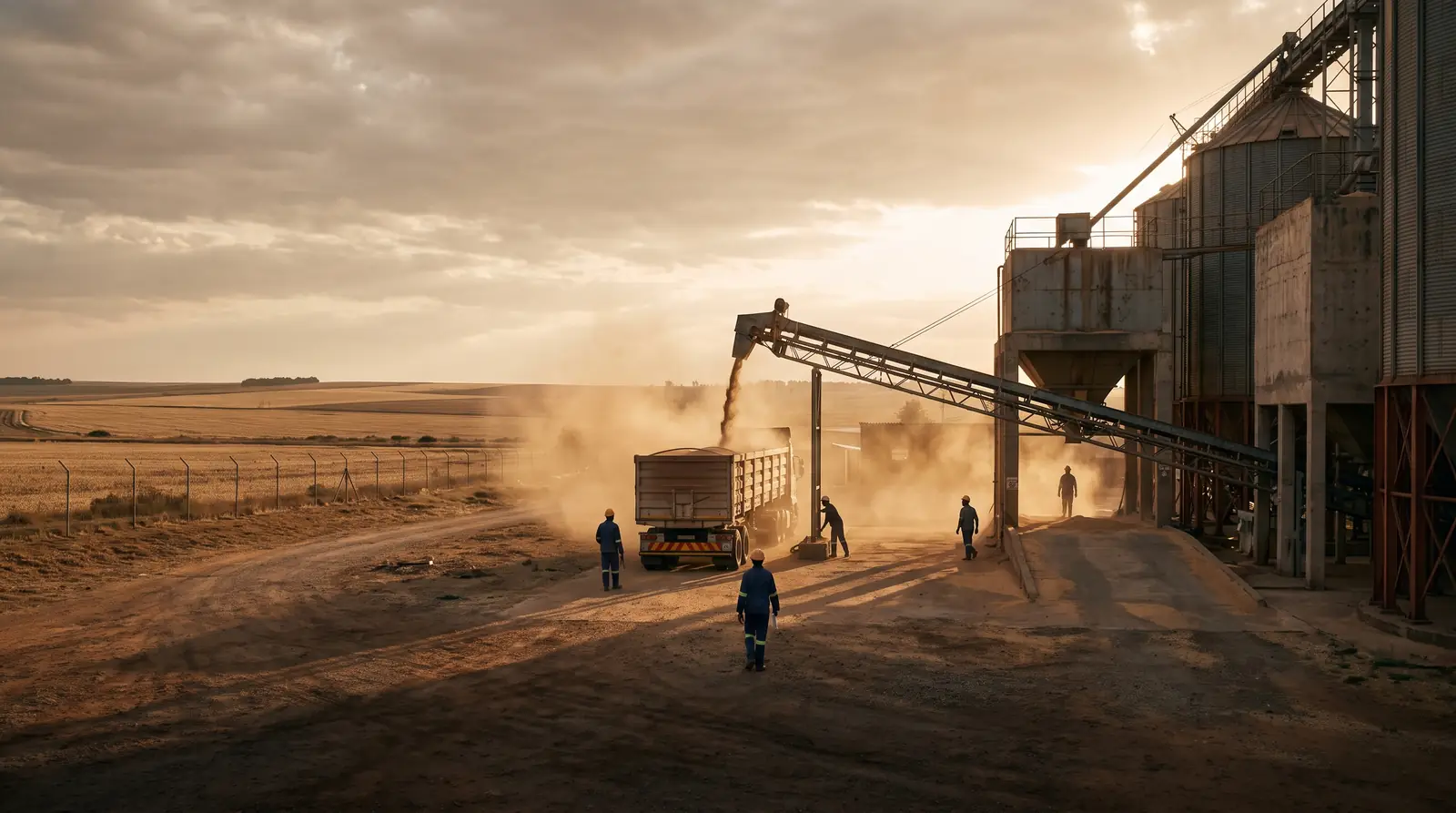
A large share of what is planted never reaches a buyer. It rots in the field waiting for transport, spoils in an unventilated store, or is sold at a loss into a glutted local market on harvest day.
Storage and cold chain raise a farmer's income without raising a single yield figure. They are consistently the cheapest intervention and the least funded.
A season can deliver a normal total and still fail, if the rain arrives three weeks late or stops during grain fill.
Irrigation is not mainly about arid land. It is about removing the timing risk, which is what stops a farmer from investing in better seed and fertiliser in the first place.
Farm credit has to be advanced before planting and repaid after harvest, secured by an asset a bank does not want. So it is rarely offered, and where offered, it is priced for the worst case.
Without it a farmer cannot buy inputs, and without inputs the yield stays low. That loop is the mechanism behind the falling number.
Production projects that begin with a buyer under contract behave differently from production projects that begin with a grant. The buyer sets the variety, the grade and the delivery date, and those specifications organise everything upstream.
Schemes that produce first and look for a market afterwards fail at a remarkably consistent rate.
What it means/03
The harvest
already exists.
This is not a problem of growing more. It is storage, cold chain and roads, which are known engineering with known returns. Fixing the journey pays twice: the farmer earns more and the city eats cheaper.
The Brief/
The NextStep Africa
Brief.
What the engine turns up, every fortnight. From Lagos.
- What moved
- The change that mattered, and the number under it.
- How it connects
- The systems involved, and what one does to another.
- What it turns on
- What has to go right, and who is already building it.
- What to watch
- One indicator, and when it resolves.
SubscribeNO. 14 / T-09 DAYS
FREE. EVERY SECOND TUESDAY. READ BY DECISION-MAKERS ON THREE CONTINENTS. ONE CLICK TO LEAVE.
From the founder's desk.
NextStep Africa / Lagos